Reactive Skin Barrier Rehabilitation Protocol: Healing Lipid Depletion & Chronic Erythema
In an era dominated by aggressive multi-acid peels, 1% retinols, and abrasive 10-step regimens, cutaneous barrier failure has reached epidemic proportions. When the skin stings upon contact with plain tap water, the issue is not sensitivity—it is acute lipid architectural collapse.
Pathophysiology of Barrier Failure
- 1. Intercellular Lipid Delipidation: Harsh foaming cleansers and high-concentration alcohol solvents strip ceramides, free fatty acids, and cholesterol from extracellular lamellar bilayers.
- 2. Unchecked TEWL Elevation: Transepidermal water loss skyrockets above 25 g/m²/h, dehydrating live keratinocytes in the stratum spinosum and halting endogenous lipid-producing enzymes.
- 3. Neurosensory TRPV1 Activation: With corneocyte shields breached, sub-epidermal C-nerve fibers are exposed to ambient temperature shifts and cosmetics, releasing substance P and calcitonin gene-related peptide (CGRP) to induce burning erythema.
1. The Biophysics of Transepidermal Water Loss (TEWL)
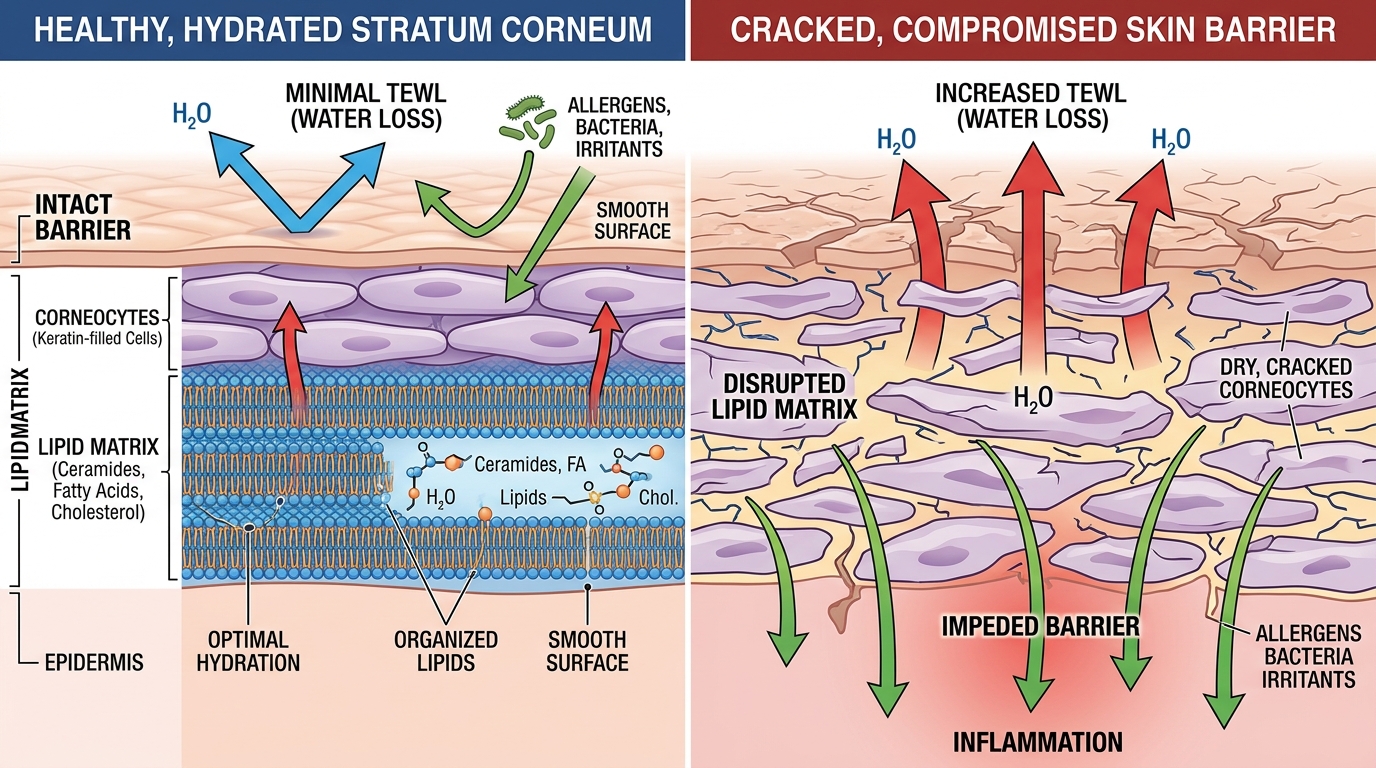
The uppermost 15 to 20 micrometers of human skin, the stratum corneum, functions as a high-efficiency biological vapor barrier. In healthy skin, evaporative water diffusion—quantified using an evaporimeter as Transepidermal Water Loss (TEWL)—measures between 4 and 8 grams per square meter per hour (g/m²/h).
When consumers combine daily alpha-hydroxy acids (Glycolic, Lactic) with prescription retinoids and foaming sulfate washes, the intercellular lipid lamellae are solubilized and stripped away. TEWL surges to 25 to 45 g/m²/h.
Patients frequently ask: "Why does room-temperature water burn my face like battery acid?" Plain water has a neutral to slightly alkaline pH (7.0 to 8.0) and zero osmolality compared to intracellular fluid. When applied to a barrier devoid of lipid shielding, water causes rapid osmotic shock to denuded epidermal nerve endings, depolarizing TRPV1 (transient receptor potential vanilloid 1) thermal/chemical receptors that transmit intense burning pain to the central nervous system.
If the flare-up manifests as clustered red papules around the mouth or nasolabial folds, check our clinical diagnostic guide: Perioral Dermatitis & Zero-Therapy.
2. The 3:1:1 Physiological Lipid Ratio: Dr. Peter Elias's Discovery
A common misconception is that slathering pure plant oil (such as rosehip, argan, or coconut oil) will repair a broken barrier. In reality, single-lipid applications frequently delay barrier repair by creating an unbalanced lipid phase inside the stratum corneum.
Pioneering research conducted by dermatologist Dr. Peter Elias at the University of California San Francisco demonstrated that the extracellular matrix requires an exact equimolar or mass ratio of three biological lipid classes:
| Lipid Component | Target Stoichiometry | Specific Bioactive Molecules | Biochemical Function |
|---|---|---|---|
| Ceramides | 3 Parts (50% Mass) | Ceramide EOS, NP, AP, EOP | Interlocks with corneocytes to form crystalline lamellar sheets |
| Cholesterol | 1 Part (25% Mass) | Pure plant sterols / Cholesterol | Fluidity modulator; prevents ceramide crystallization and rigidity |
| Free Fatty Acids | 1 Part (15% Mass) | Linoleic Acid, Palmitic Acid, Stearic Acid | Supplies protons to maintain acidic acid mantle (pH 4.5–5.5) |
When applied in this precise 3:1:1 proportion, lamellar body exocytosis in basal keratinocytes accelerates, and normal TEWL is re-established within 24 to 48 hours.
3. The 4-Stage Dermal Rehabilitation Protocol
Stop all cleansers, toners, direct acids, retinoids, essential oils, and physical scrubs. Cleanse only with cool or lukewarm water. If water causes severe stinging, use a sterile isotonic thermal spring water spray blotted gently with 100% unbleached cotton. Apply only pure medical-grade USP petrolatum or pharmaceutical squalane.
Once acute stinging subsides, introduce a sterile, fragrance-free lipid barrier emulsion containing Ceramides (NP/AP/EOP), plant sterols, and bio-fermented Ectoin. Ectoin forms a protective hydration shell around cellular membranes, blocking osmotic stress; learn about accelerated healing kinetics in Centella Asiatica & Asiaticoside Science.
Introduce a non-foaming, surfactant-free oat or micellar milk cleanser adjusted to pH 5.0. Beta-glucan from colloidal oatmeal downregulates inflammatory NF-κB pathways while gentle polyhydroxy acids (PHAs) provide mild hydration without stinging; review PHA Gluconolactone vs Salicylic Acid.
Only reintroduce active ingredients once TEWL measures under 10 g/m²/h and zero stinging occurs with sunscreen. Reintroduce one single active per week, starting with gentle anti-inflammatory azelaic acid (10–15%); consult Rosacea Subtype Mapping & Azelaic Acid.
4. Celebrity Skin Realism: Filter-Free Transparency
In recent years, celebrity figures such as Hailey Bieber and Selena Gomez have openly shared their private struggles with perioral dermatitis, chronic flushing, and acute barrier breakdown.
When social media filters are removed, the reality becomes clear: high-profile celebrities frequently trigger acute inflammatory dermatitis by layering too many active PR samples simultaneously. Their turnaround protocols do not rely on $1,000 diamond facials; they rely on zero-therapy, lipid lamellar creams, and eliminating fragrance.
Frequently Asked Questions: Damaged Skin Barrier Repair
What does a severely damaged skin barrier feel like?
A severely damaged stratum corneum manifests as persistent facial tightness, a burning sensation when applying plain room-temperature water or gentle moisturizers, rough sandpapery flaking, diffuse erythema (redness), and sudden hypersensitivity to products previously tolerated without issue.
How long does it realistically take to repair a destroyed moisture barrier?
Complete physiological restoration requires 4 to 8 weeks. While superficial stratum corneum hydration and stinging relief can occur within 5 to 7 days of eliminating irritants, re-establishing mature lamellar lipid bilayers and down-regulating sensitized TRPV1 nerve receptors requires a full 28-day epidermal turnover cycle.
What is the 3:1:1 physiological lipid ratio in barrier repair creams?
Pioneered by Dr. Peter Elias in dermatological barrier biology, the 3:1:1 ratio refers to an equimolar/mass formulation of 3 parts Ceramides, 1 part Cholesterol, and 1 part Free Fatty Acids. When applied in this exact stoichiometric proportion, the lipids rapidly assimilate into damaged intercellular spaces, accelerating barrier recovery by over 40% compared to single-lipid emollients.