Centella Asiatica & Asiaticoside: Isolated Triterpenes & Barrier Repair Speeds
Known colloquially as "Cica" or Tiger Grass, Centella Asiatica is celebrated across global dermatology. But the distinction between unpurified botanical plant teas and pharmaceutical-grade isolated pentacyclic triterpenes determines whether a formulation delivers true cellular collagenesis or merely marketing appeal.
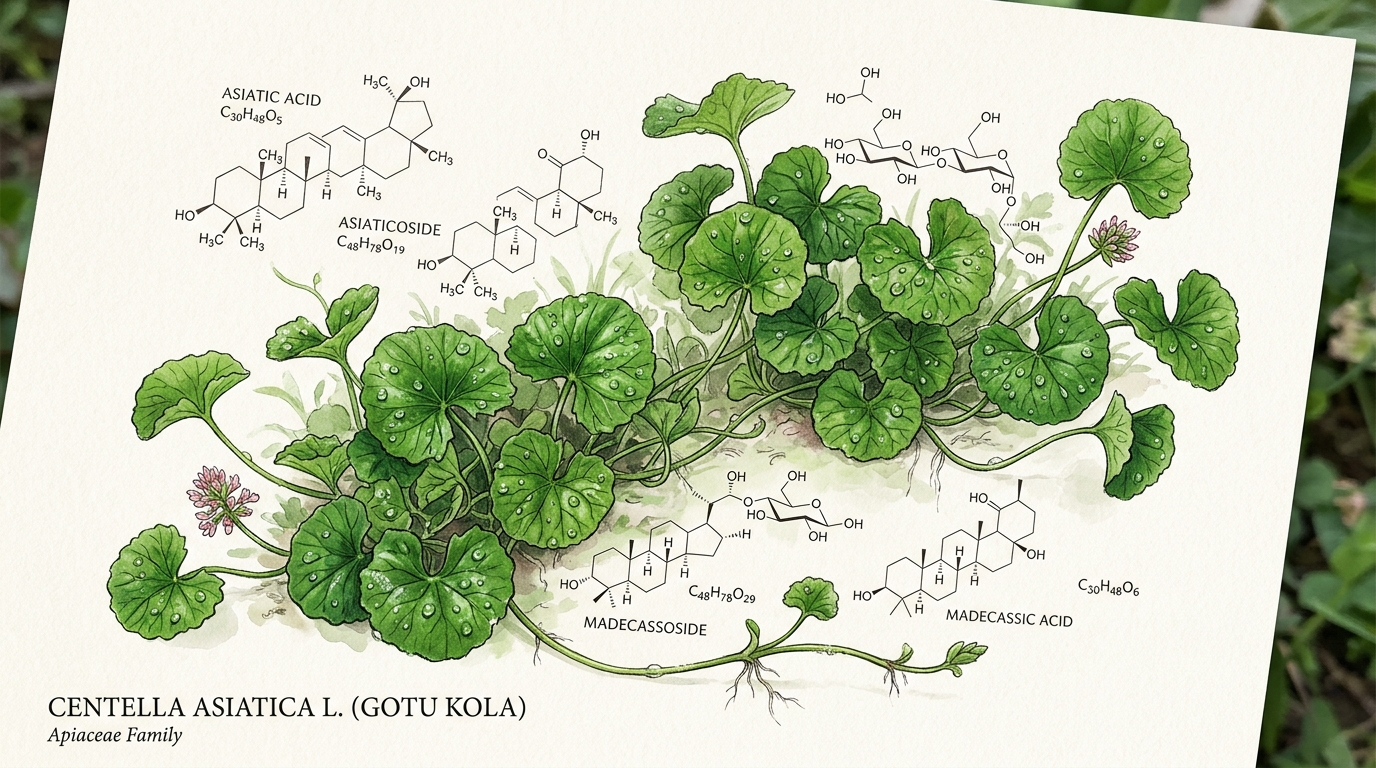
1. The Phytochemical Quartet: Four Isolated Pentacyclic Triterpenes
Centella Asiatica is a perennial marsh plant native to the wetlands of Asia. In clinical pharmacognosy, therapeutic efficacy does not derive from the whole leaf; it is concentrated in four distinct pentacyclic triterpenoid saponins and sapogenins:
Asiaticoside (MW 959 Da)
The primary driver of structural tissue repair. Asiaticoside binds directly to human dermal fibroblasts, stimulating the transcription of Type I collagen and inducing early vascular endothelial growth factor (VEGF) to promote capillary re-epithelialization.
Madecassoside (MW 975 Da)
The anti-inflammatory powerhouse. Madecassoside downregulates nuclear factor-kappa B (NF-κB), suppressing the secretion of pro-inflammatory cytokines interleukin-1beta (IL-1β) and tumor necrosis factor-alpha (TNF-α) to quell acute stinging.
Asiatic Acid (MW 488 Da)
Possessing a molecular weight under the 500-Dalton penetration threshold, Asiatic Acid penetrates easily into viable epidermal layers, stimulating glycosaminoglycan (hyaluronic acid) synthesis and preventing elastase-mediated matrix destruction.
Madecassic Acid (MW 504 Da)
A potent wound-healing aglycone that promotes migration of basal keratinocytes across denuded basement membranes, accelerating closure of microscopic excoriations and chemical peel micro-injuries.
Learn how these triterpenes fit into systemic barrier rehabilitation in our guide: The Reactive Skin Barrier Rehabilitation Protocol.
2. Cellular Kinetics: The TGF-β / Smad Signaling Cascade
How do plant saponins stimulate human structural proteins? In-vitro cell culture studies demonstrate that when Asiaticoside encounters human dermal fibroblasts:
- 1. Asiaticoside binds and activates the Transforming Growth Factor-beta Receptor I (TGF-βRI) kinase.
- 2. This receptor kinase phosphorylates cytoplasmic Smad2 and Smad3 transcription factors.
- 3. Phosphorylated Smads complex with Smad4 and translocate across the nuclear membrane.
- 4. In the nucleus, the Smad complex binds promoter regions of the COL1A1 and COL1A2 genes, increasing pro-collagen Type I protein synthesis by up to 35% within 48 hours.
Crucially, this collagenesis occurs without triggering hyper-trophic keloid scarring, as Asiaticoside concurrently upregulates tissue inhibitor of metalloproteinases (TIMP-1), maintaining balanced physiological remodeling.
3. TECA Standardization vs. Crude Cosmetic "Centella Water"
Many mass-market commercial serums list "Centella Asiatica Leaf Water (85%)" on their labels. In reality, leaf water is the steam distillate leftover from essential oil production, containing virtually zero bioactive triterpenes.
Pharmaceutical and clinical-grade formulations utilize TECA (Titrated Extract of Centella Asiatica), an internationally standardized dry extract comprising:
- 40% Asiaticoside (pure crystalline glucoside)
- 60% Genins (30% Madecassic Acid + 30% Asiatic Acid)
Clinical trials evaluating TECA at concentrations between 0.1% and 1.0% prove that post-laser or post-peel re-epithelialization speeds accelerate by up to 40% compared to simple petrolatum or saline controls.
For individuals navigating rosacea flushing alongside barrier breakdown, review our trigger-elimination protocols in Rosacea Subtypes & Azelaic Acid.
Frequently Asked Questions: Centella Asiatica Science
What is the difference between crude Centella Asiatica extract and isolated Madecassoside?
Crude Centella Asiatica extract is a broad botanical mixture consisting of water, volatile essential oils, flavonoids, and variable low concentrations of active saponins. In contrast, isolated Madecassoside is a purified, pharmaceutical-grade pentacyclic triterpene glucoside (>95% purity) that selectively inhibits inflammatory cytokines (IL-1beta, TNF-alpha) and stimulates collagen synthesis with consistent, reproducible cellular kinetics.
How does Asiaticoside stimulate Type I collagen synthesis in dermal fibroblasts?
Asiaticoside directly activates the Transforming Growth Factor-beta (TGF-beta) receptor complex on dermal fibroblasts. This phosphorylation cascade triggers intracellular Smad2 and Smad3 signaling pathways, which enter the cell nucleus to upregulate the COL1A1 and COL1A2 genes responsible for synthesizing mature Type I collagen fibers.
How fast does CICA repair a damaged stratum corneum compared to standard moisturizers?
Clinical transepidermal water loss (TEWL) recovery studies demonstrate that topical formulations containing standardized Titrated Extract of Centella Asiatica (TECA) restore baseline barrier function up to 40% faster than vehicle controls, re-establishing mature lipid bilayers within 72 to 96 hours following acute chemical or mechanical abrasion.