PHA Gluconolactone vs Salicylic Acid: Chemical Exfoliation for Reactive Barriers
When skin exhibits persistent erythema, perioral flaking, or compromised lipid lamellae, standard beta hydroxy acid (BHA) treatments often precipitate stinging and barrier breakdown. Here is how second-generation polyhydroxy acids provide safe cell renewal.
Key Comparative Takeaways
- Molecular Weight Discrepancy: Gluconolactone (178.14 g/mol) and lactobionic acid (358.3 g/mol) possess significantly greater molecular bulk than salicylic acid (138.12 g/mol), preventing precipitate penetration into viable dermal layers.
- Poly-Hydroxyl Water Binding: PHAs feature multiple hydroxyl (-OH) groups, endowing them with intrinsic humectant properties that increase stratum corneum hydration during exfoliation.
- Metal Chelation Properties: Gluconolactone chelates pro-oxidative divalent iron and copper ions, dampening free radical oxidative stress and neurogenic erythema.
- Barrier Integrity Preservation: Transepidermal water loss (TEWL) measurements confirm that 8% gluconolactone preserves stratum corneum lipid organization while 2% salicylic acid frequently disrupts lamellar order in compromised skin.
1. The Reactive Barrier Dilemma: Why Classic Exfoliants Fail
In dermatological cosmetics, the two conventional standards for chemical desquamation have long been alpha hydroxy acids (specifically glycolic and lactic acid) and beta hydroxy acids (salicylic acid). However, in individuals diagnosed with erythematotelangiectatic rosacea, perioral dermatitis, seborrheic dermatitis, or severe cutaneous barrier compromise, both AHA and BHA interventions present formidable clinical hurdles.
Glycolic acid, with its microscopic molecular weight of 76 Da, rushes through compromised epidermal intercellular channels, activating sensory C-fibers and triggering instant neurogenic stinging and vascular flush. Salicylic acid, while oil-soluble and anti-inflammatory at low concentrations, acts as a potent keratolytic and organic solvent. It solubilizes intercellular cholesterol, ceramides, and fatty acids alongside follicular sebum. In skin that already suffers from barrier lipid depletion, 2% salicylic acid strips the fragile moisture seal, elevating transepidermal water loss (TEWL) and initiating a vicious cycle of reactive flaking and rebound erythema.
2. The Architecture of Polyhydroxy Acids: Molecular Bulk & Humectancy
Polyhydroxy acids (PHAs) were patented by Dr. Eugene Van Scott and Dr. Ruey Yu as next-generation hydroxy carboxylic acids. The defining characteristic of a PHA is the presence of multiple hydroxyl groups attached to a cyclic or open-chain carbohydrate backbone.
| Exfoliating Acid | Class | Molecular Weight | Hydroxyl (-OH) Groups | Barrier Impact (TEWL) |
|---|---|---|---|---|
| Salicylic Acid | BHA (Lipophilic) | 138.12 Da | 1 -OH group | Increases TEWL in depleted barriers |
| Glycolic Acid | AHA (Hydrophilic) | 76.05 Da | 1 -OH group | High sensory irritation / stinging risk |
| Gluconolactone | PHA (Hydrophilic) | 178.14 Da | 4 -OH groups | Maintains or decreases TEWL (hydrating) |
| Lactobionic Acid | Bionic PHA | 358.30 Da | 8 -OH groups | Intensely humectant gel-forming matrix |
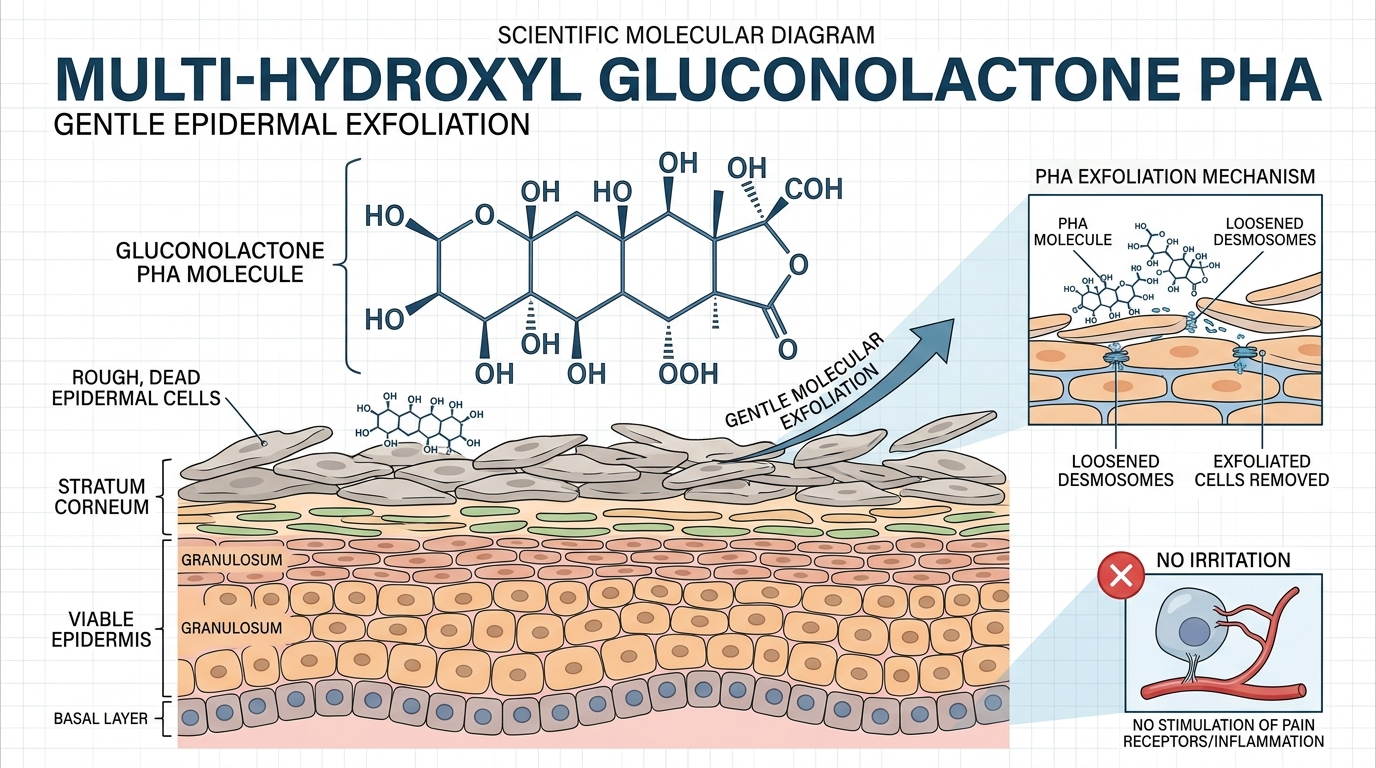
Because gluconolactone is structurally larger than salicylic acid, its diffusion coefficient through the stratum corneum is substantially lower. It does not cascade into deeper living layers of the epidermis. Instead, it systematically dissolves ionic bonds holding desmosomes together exclusively on the uppermost layers of dead corneocytes. The exfoliation occurs gradually and evenly, completely eliminating the burning sensation characteristic of AHAs.
3. The Dual Action: Humectancy and Metal Chelation
Unlike traditional chemical exfoliants that dry the epidermis, gluconolactone contains four polar hydroxyl groups that actively bind atmospheric moisture through hydrogen bonding, functioning identically to natural moisturizing factor (NMF) humectants. In clinical corneometer evaluations, patients treated with 8% gluconolactone show a statistically significant increase in stratum corneum hydration alongside visible reduction in surface texture roughness.
Furthermore, gluconolactone possesses a unique molecular capability: chelation of transition metal ions. In inflammatory conditions like rosacea and barrier degradation, unbound ferric (Fe2+) and cupric (Cu2+) ions catalyze the Fenton reaction, converting hydrogen peroxide into destructive hydroxyl free radicals that attack lipid membranes. By sequestering these metal catalysts, gluconolactone exhibits potent antioxidant and anti-inflammatory activity, quieting redness rather than exacerbating it.
4. Clinical Decision Guide: PHA vs BHA Matching
While polyhydroxy acids are superior for sensitive and barrier-compromised profiles, salicylic acid retains clear superiority in specific sebum-dense conditions:
When to Select PHA (Gluconolactone 4%–10%)
- Subtype 1 or Subtype 2 Rosacea with visible microvascular flushing.
- Recovering barrier post-procedure (laser, microneedling, or medium chemical peels).
- Post-perioral dermatitis skin requiring gentle texture smoothing.
- Dry, flaking, or mature skin prone to congestion that cannot tolerate lipid removal.
- Daytime routines where zero photosensitization is desired.
When to Select BHA (Salicylic Acid 1%–2%)
- Dense, hyper-sebaceous skin with resilient epidermal thickness.
- Deep closed comedones and microcomedones embedded inside oily follicular pores.
- Stubborn blackheads (open comedones) on nasal and chin areas.
- Active acne vulgaris where lipophilic follicular penetration is mandatory.
5. How to Integrate Gluconolactone into a Barrier-Safe Protocol
To achieve optimal cellular desquamation without risking micro-inflammatory flare-ups, formulate or layer gluconolactone according to the following guidelines:
- Optimal pH Window: Gluconolactone requires a formulation pH between 3.8 and 4.4. This maintains sufficient free acid availability for desmosome cleavage while remaining well within the physiological buffer zone of human skin.
- Pairing with Soothing Hydrosols: Combine gluconolactone in an essence or toner format alongside Centella asiatica (asiaticoside), beta-glucan, and panthenol to accelerate simultaneous barrier repair.
- Frequency: Introduce at 5% concentration 2–3 evenings per week. Once cutaneous tolerance is confirmed, gluconolactone can be utilized nightly without inducing barrier depletion.
Frequently Asked Questions: Polyhydroxy Acids
Why are PHAs gentler on sensitive skin than salicylic acid or glycolic acid?
Polyhydroxy acids like gluconolactone (178 Da) and lactobionic acid (358 Da) have significantly larger molecular structures than glycolic acid (76 Da) or salicylic acid (138 Da). Their larger size slows trans-epidermal penetration, limiting desquamation to the outermost corneocyte layers without triggering neurogenic stinging, sensory irritation, or micro-inflammation.
Can gluconolactone unclog pores as effectively as salicylic acid?
Salicylic acid is lipophilic and uniquely dissolves oil inside the sebaceous pore. Gluconolactone is water-soluble, meaning it exfoliates the surface stratum corneum and prevents follicular plugs from sealing. For individuals with sensitive, rosacea-prone, or barrier-compromised skin who cannot tolerate daily BHA, 4% to 10% gluconolactone provides gentle keratolytic clearing without drying or stripping lipid bilayers.
Do PHAs increase photosensitivity like AHAs?
Unlike traditional glycolic acid, clinical research shows gluconolactone does not increase UV-induced sunburn cell formation. In fact, due to its polyhydroxy structure, gluconolactone functions as an antioxidant and metal chelator, offering mild photoprotective properties against hydroxyl radical generation.