Rabbit Ear Comedogenicity Testing Myths: Why the 0–5 Scale Fails Human Skin Biology
Consumer skincare databases routinely label ingredients as "pore-clogging" based on animal testing conducted fifty years ago. Here is the clinical reality behind the rabbit ear assay, species follicular divergence, and why ingredient percentages render isolated ratings obsolete.
Key Formulative Takeaways
- The Historical Flaw: The Rabbit Ear Assay (REA), pioneered in 1968–1972 by Kligman and Mills, applied pure 100% chemical substances under occlusive conditions to rabbit ear canals, which exhibit hyper-reactive follicular epithelia not found on human faces.
- Finished Product vs. Raw Ingredient: An ingredient rated 4/5 on the REA at 100% concentration frequently exhibits 0 comedogenicity when formulated at 0.5%–2% in an emulsion.
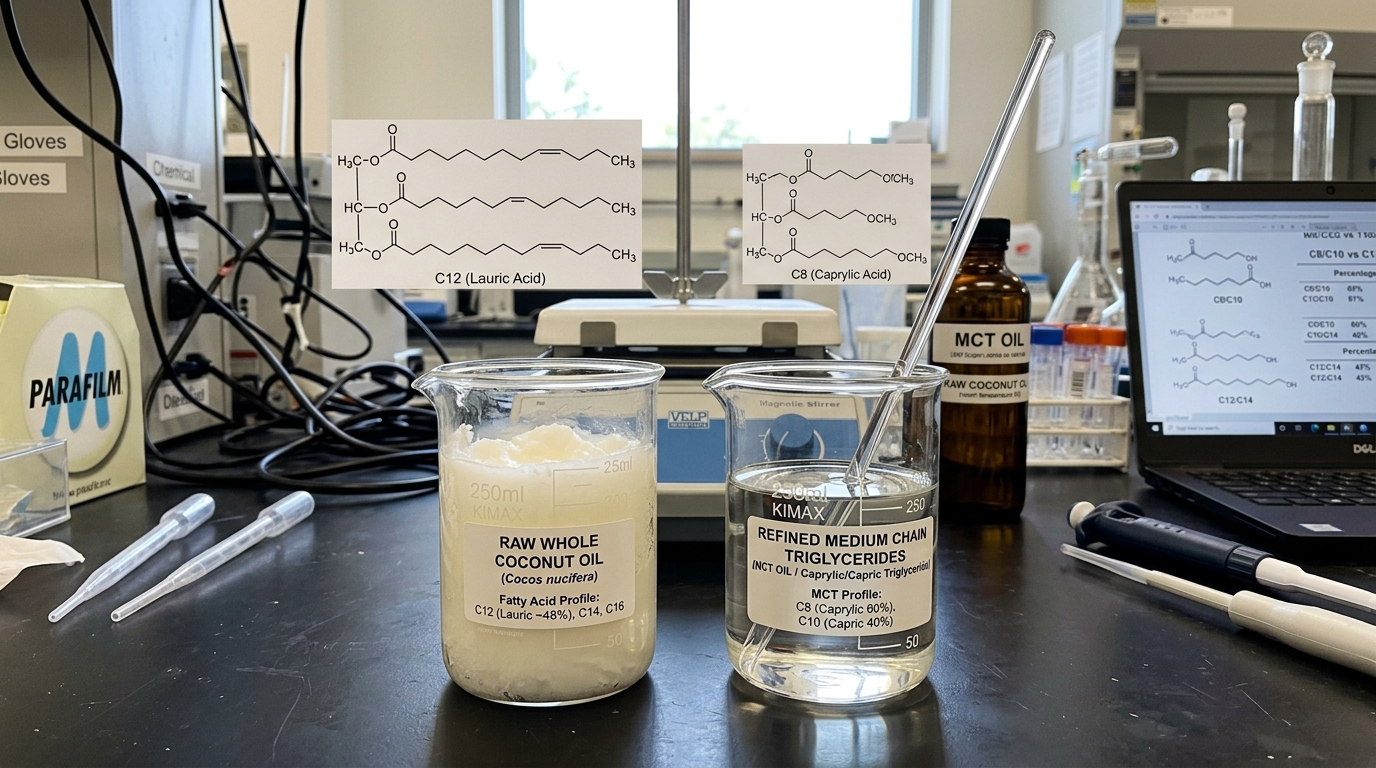
- Lipid Molecular Conformation: Fractionated Medium-Chain Triglyceride (MCT) oil behaves entirely differently than crude cold-pressed coconut oil due to fatty acid chain truncation (C8/C10 vs C12/C14/C16).
- Human Human Follicular Biopsy: Cyanoacrylate surface biopsies on human volunteers demonstrate that modern finished cosmetic formulations rarely induce microcomedones even when containing trace "comedogenic" esters.
1. Genesis of the Rabbit Ear Assay: Kligman's 1970s Laboratory Paradigm
To understand why digital cosmetic ingredient scanners flag essential skincare components as dangerous "comedogenic hazards," one must examine the history of dermatological testing. In the late 1960s and early 1970s, dermatologists Dr. Albert M. Kligman and Dr. James E. Fulton sought a rapid screening model to identify which cosmetic raw materials induced acne cosmetica.
The New Zealand White rabbit inner ear canal was chosen because its pilosebaceous follicles are anatomically large, hairless, and exceptionally sensitive to chemical irritation. Researchers instilled undiluted raw chemicals into the external auditory canal daily for two weeks, covered with occlusive dressings. Afterwards, epidermal peels or histological cross-sections were evaluated under optical stereomicroscopes for keratinous impactions inside the follicular infundibulum.
The resulting scale categorized raw materials from 0 (completely non-comedogenic) to 5 (severely comedogenic). However, the model possessed fundamental methodological design choices that make direct translation to modern human skin scientifically invalid:
| Parameter | Rabbit Ear Canal Assay (REA) | Human Facial Follicular Biology |
|---|---|---|
| Follicular Epithelium Sensitivity | Extreme hyper-reactivity; forms hyperkeratotic plugs from mild friction or saline | Controlled squamous desquamation regulated by transglutaminase and filaggrin |
| Application Concentration | 100% pure undiluted single ingredient | 0.05% to 5.0% dispersed within emulsified multi-component matrix |
| Occlusion & Exposure | Prolonged continuous occlusion in enclosed ear canal | Atmospheric exposure, sebum dilution, sweat, and diurnal washing |
| Microbiome Composition | Absent human-specific lipid metabolizers | Cutibacterium acnes, Malassezia restricta, Staphylococcus epidermidis |
2. Why Raw Ingredient Scores Do Not Predict Finished Formula Behavior
The fatal flaw in consumer comedogenicity lists is treating an emulsion like a simple sum of its parts. In physical chemistry, an emulsion is a thermodynamically stabilized colloidal system consisting of dispersed oil droplets suspended in a continuous aqueous phase (or vice versa), shielded by amphiphilic surfactant bilayers.
Consider isopropyl myristate (IPM), an ester rated a notorious 5/5 on historical rabbit ear scales. When pure IPM is poured into a rabbit ear canal, its low viscosity and aggressive solvent properties disrupt follicular keratinocyte adhesion, causing rapid hyperkeratotic shedding. However, when IPM is incorporated at 1.5% in an oil-in-water cream, its thermodynamic activity is reduced by several orders of magnitude. The ester molecules are sequestered inside micellar core structures or surface lipid films, preventing concentrated penetration into the follicular duct.
In 1989, Dr. Kligman himself published a critical retrospective paper titled "Comedogenicity of noncomedogenic products: the rabbit ear revisited", wherein he explicitly conceded:
"Substances that are comedogenic when applied alone at 100% are rarely comedogenic when incorporated into finished formulas at usual functional concentrations. The comedogenicity of a product cannot be predicted simply from the comedogenic properties of its individual components."
3. The Coconut Oil Paradox: Virgin Whole Oil vs. Fractionated MCT Oil
Few topics generate as much confusion in clean beauty circles as coconut-derived lipids. Virgin cold-pressed coconut oil (Cocos nucifera) is rated a 4 out of 5 on conventional comedogenicity indexes, leading many consumers to boycott all coconut derivatives. However, molecular fractionation alters lipid biochemistry completely.
Crude Virgin Coconut Oil (C12–C18)
Composed predominantly of Lauric Acid (C12:0 ~49%), Myristic Acid (C14:0 ~18%), and Palmitic Acid (C16:0 ~9%).
- Melting point: ~24°C–25°C (solid at room temperature).
- High molecular crystallization tendency inside human sebaceous infundibulum.
- Direct carbon chain source (C12–C16) consumed by Malassezia yeasts, triggering inflammatory pityrosporum folliculitis.
Fractionated MCT Oil (Caprylic/Capric C8–C10)
Produced by steam hydrolysis and molecular fractionation to isolate only Caprylic Acid (C8:0 ~60%) and Capric Acid (C10:0 ~40%) esterified to glycerin.
- Melting point: -4°C (remains completely liquid).
- Low molecular surface tension; does not crystalize or pack within follicular ducts.
- Incapable of supporting Malassezia growth; carbon chains < C11 cannot be utilized by lipase-cleaving yeasts.
When an ingredient scanning app detects "Caprylic/Capric Triglyceride" on a skincare label and flags it because it originates from coconut, it commits an elementary biochemical error. Molecular length, branching, saturation, and melting point dictate biological behavior—not botanical origin.
4. Human In-Vivo Comedogenicity Testing: The Modern Gold Standard
To overcome the limitations of the rabbit ear assay, contemporary clinical testing relies on human volunteer protocols. The two primary validated methodologies are:
- Cyanoacrylate Surface Biopsy (CSB): A drop of medical-grade cyanoacrylate is placed on a glass microscope slide and pressed firmly against the upper back or cheek of human subjects who have applied the test formula daily for 4 weeks. Upon removal, the superficial layer of the stratum corneum and the contents of the follicular infundibula (keratinous plugs and sebum cores) are stripped away intact. The density and size of microcomedones are then quantified per square centimeter under polarized light microscopy.
- Controlled Repeated Open Application Testing (ROAT): Products are applied twice daily to human facial skin in subjects with mild microcomedonal tendencies over a 6-to-12-week timeframe, evaluated via high-resolution epiluminescence dermoscopy.
Human trials repeatedly show that products formulated with ingredients rated 2, 3, or even 4 on the historical rabbit ear index—such as cetearyl alcohol, ceteareth-20, or stearic acid—show zero statistically significant elevation in microcomedone counts when the overall formulation is properly balanced and non-occlusive.
5. A Rational Framework for Evaluating Pore-Clogging Potential
Rather than memorizing arbitrary 0–5 lists, clinical aestheticians and cosmetic chemists assess comedogenic risk based on four objective physico-chemical parameters:
Lipids that are waxy or solid at human skin surface temperature (32°C–34°C) carry higher physical clogging potential than lipids that remain fluid liquids.
A light gel-cream or watery essence containing 1% of a rich ester will evaporate cleanly, whereas an occlusive petrolatum ointment containing that same ester will trap follicular debris.
Endogenous squalene in human sebum oxidizes into squalene peroxide under UV and pollution exposure, which is 10x more comedogenic than any cosmetic ingredient.
Whether congestion is driven by C. acnes hyper-colonization or Malassezia fungal yeast overgrowth dictates which lipid chains must be eliminated.
Frequently Asked Questions: Comedogenicity Testing
What is the rabbit ear assay (REA) for comedogenicity?
The rabbit ear assay was developed in the late 1960s and 1970s by Dr. Albert Kligman. Raw cosmetic ingredients were applied at 100% concentration to the inner ear canal of New Zealand white rabbits for two to three weeks to observe follicular hyperkeratosis and microcomedone formation under a stereomicroscope.
Why is the 0-5 comedogenicity scale considered unreliable for humans?
The rabbit inner ear is dramatically more sensitive to follicular irritation and hyperkeratosis than human facial skin. Furthermore, testing raw ingredients at 100% concentration ignores concentration thresholds, formulation delivery vehicles, solubilizers, and evaporation rates in finished skincare products.
Why does fractionated MCT oil behave differently than raw coconut oil?
Virgin coconut oil contains approximately 50% lauric acid (C12) along with myristic (C14) and palmitic (C16) acids, which have high melting points and can solidify in follicular infundibula or feed Malassezia. Pure MCT oil consists solely of C8 (caprylic) and C10 (capric) triglycerides, which remain lightweight, liquid at room temperature, and non-comedogenic.