Panthenol (Pro-Vitamin B5): Fibroblast Proliferation & Re-Epithelialization Kinetics
Widely recognized in over-the-counter soothing balms, panthenol (dexpanthenol) is routinely mistaken for a passive humectant. In cutaneous biology, however, this stable provitamin acts as an essential metabolic precursor to Coenzyme A (CoA). By fueling cellular bioenergetics, dexpanthenol orchestrates basal keratinocyte re-epithelialization, mobilizes dermal fibroblasts, and stimulates the enzymatic synthesis of mature epidermal barrier lipids.
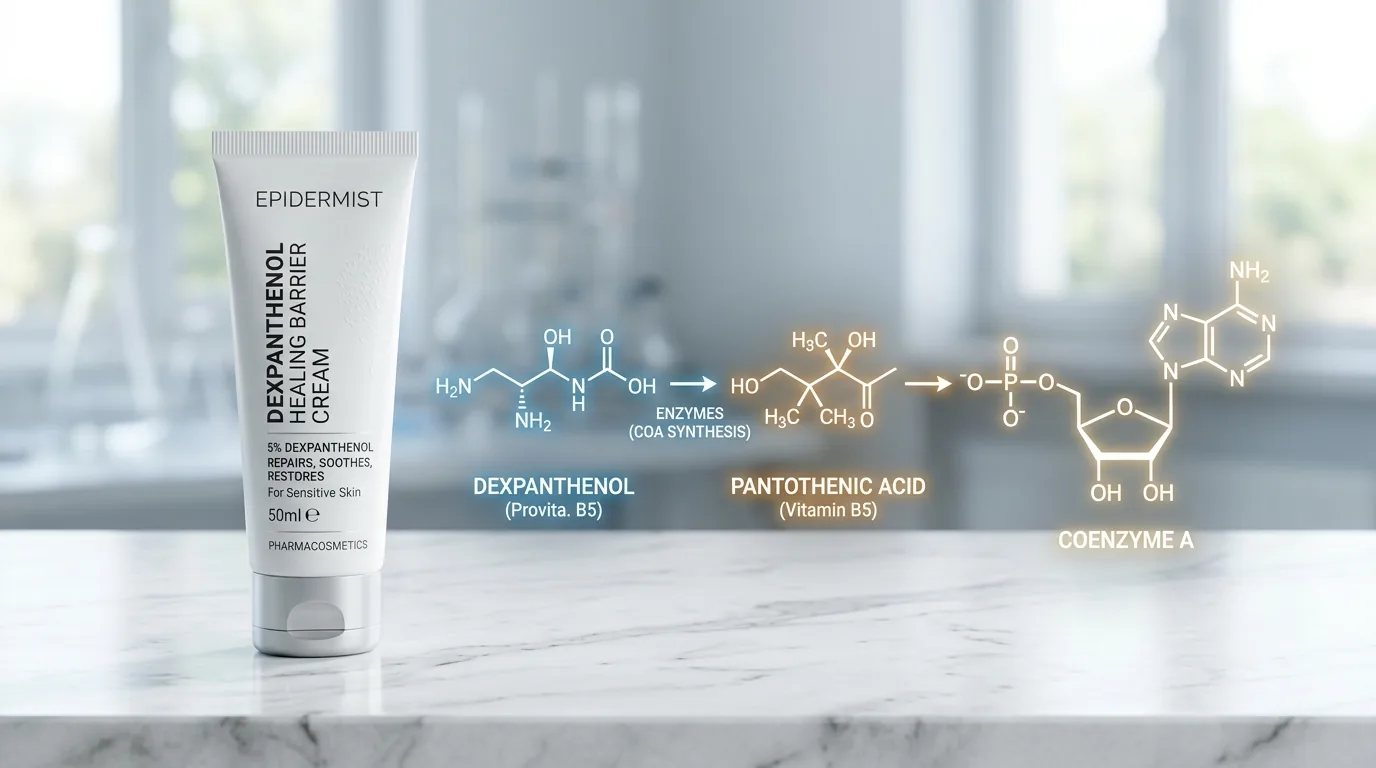
1. The Provitamin Cascade: Stereospecificity & Cutaneous Biotransformation
Pantothenic acid (Vitamin B5) is a water-soluble vitamin required by every living eukaryotic cell. However, formulating native pantothenic acid into topical skincare presents substantial cosmetic chemistry challenges: it is hygroscopic, chemically labile, and possesses high surface tension that impairs trans-epidermal flux.
To overcome these penetration barriers, pharmaceutical dermatologists utilize the stable alcohol analog: dexpanthenol (D-panthenol). Possessing a low molecular weight of 205.25 Da and balanced lipophilic-hydrophilic partitioning, dexpanthenol readily crosses the stratum corneum barrier. Once inside viable epidermal keratinocytes, it is enzymatically oxidized to pantothenic acid via cellular NAD-dependent alcohol dehydrogenases:
1. Topical D-panthenol penetrates the stratum corneum and enters basal keratinocytes.
2. Cutaneous alcohol dehydrogenases oxidize D-panthenol → D-pantothenic acid (Vitamin B5).
3. Pantothenate Kinase (PANK) phosphorylates B5 → 4′-Phosphopantothenate.
4. Condensation with L-cysteine → 4′-Phosphopantothenoyl-L-cysteine.
5. Decarboxylation & adenylation → Dephospho-CoA → Mature Coenzyme A (CoA).
The Critical Importance of Stereospecificity (D vs. L)
Formulators must distinguish between the active dextrorotatory enantiomer (D-panthenol) and the inactive levorotatory form (L-panthenol). While racemic mixtures (DL-panthenol) are frequently used in inexpensive haircare products for surface conditioning, only the D-enantiomer fits the active catalytic pocket of pantothenate kinase (PANK). L-panthenol cannot be converted into Coenzyme A and exhibits zero pro-metabolic or barrier-repair bioactivity.
To explore how nutritional cofactors interact with systemic barrier rebuilding, review The Reactive Skin Barrier Rehabilitation Protocol.
2. Cellular Bioenergetics: How Coenzyme A Drives Lamellar Lipid Synthesis
Why does a B-vitamin analog accelerate lipid barrier repair? The answer lies in the fundamental role of Coenzyme A (CoA) and its high-energy thioester derivative, Acetyl-CoA.
Healthy barrier integrity depends on lamellar bodies located within the stratum granulosum. These intracellular granules constantly synthesize and extrude equimolar ratios of ceramides, cholesterol, and free fatty acids into the extracellular space. Every step of this lipid factory is CoA-dependent:
Acyl-CoA & Ceramide Synthases
Ceramide synthesis requires the condensation of palmitoyl-CoA with L-serine by serine palmitoyltransferase. Elevated intracellular CoA pools ensure an abundant supply of long-chain fatty acyl-CoAs, upregulating the formation of crucial acylceramides (such as Ceramide EOS and NP) necessary for water impermeability.
TCA Cycle Bioenergetics
Wound closure and basal cell differentiation require tremendous cellular energy. Acetyl-CoA directly fuels the tricarboxylic acid (TCA) cycle and oxidative phosphorylation, providing the ATP necessary for keratinocytes to synthesize cornified envelope proteins (involucrin, filaggrin, loricrin).
For a deep dive into the physiological stoichiometry required for lamellar bilayer reconstruction, examine our clinical guide on Ceramide Ratios 3:1:1: Physiologic Lipid Restoration.
3. Wound Healing Kinetics: Fibroblast Migration & Re-Epithelialization
When skin experiences chemical peeling, microneedling micro-channels, or aggressive retinoid irritation, the basement membrane is compromised. Dexpanthenol orchestrates rapid tissue regeneration across two cooperative phases of wound healing:
Phase 1: Basal Keratinocyte Migration & Sheet Re-Epithelialization
During the initial 24 to 48 hours following cutaneous trauma, keratinocytes adjacent to the wound margin must detach, flatten, and migrate across denuded dermal collagen. Dexpanthenol stimulates cell motility and cytoskeletal remodeling, accelerating complete epithelial wound closure and shortening the window of infectious vulnerability.
Phase 2: Dermal Fibroblast Proliferation & Collagen Matrix Remodeling
In the deeper dermis, dexpanthenol enhances the mitotic index of human fibroblasts. Cultured human dermal fibroblasts treated with dexpanthenol demonstrate accelerated proliferation and increased synthesis of structural glycosaminoglycans and pro-collagen Type I, yielding regenerated tissue with higher tensile elasticity and minimal scar contraction.
When treating post-procedure or reactive barrier states, pairing dexpanthenol with pentacyclic triterpenes creates powerful therapeutic synergy. Review our analysis of botanical fibroblast kinetics in Centella Asiatica & Asiaticoside: Barrier Speeds.
4. Clinical Evidence: SLS Irritation Models & Formulation Benchmarks
The therapeutic efficacy of dexpanthenol is substantiated by over seven decades of rigorous clinical dermatology trials (PMID: 12113650, PMID: 21982351):
- Surfactant Challenge Protection (SLS Models): In standardized human patch test trials using 1.0% sodium lauryl sulfate (SLS) to induce acute barrier stripping, pre-treatment and post-treatment with a 2.5% dexpanthenol emulsion prevented severe barrier disruption and restored baseline transepidermal water loss (TEWL) values within 48 hours, compared to over 96 hours in untreated controls.
- Anti-Erythema & Anti-Inflammatory Kinetics: Dexpanthenol suppresses erythema (visible redness) by blunting cutaneous capillary vasodilation and downregulating pro-inflammatory cytokine cascades without triggering vascular rebound.
- Concentration Thresholds: Leave-on recovery creams formulated with 1.0% to 5.0% dexpanthenol demonstrate statistically significant increases in stratum corneum hydration and reductions in TEWL over 15 to 30 days of daily use. Wash-off products typically utilize 0.5% to 1.0% to prevent excessive tackiness while mitigating surfactant harshness.
Formulator's Summary: Dexpanthenol Specifications
Frequently Asked Questions: Panthenol Biology
Why is D-panthenol biologically active while L-panthenol is inactive?
The cellular enzymes responsible for metabolizing provitamins—specifically cutaneous alcohol dehydrogenases and pantothenate kinase (PANK)—are strictly stereospecific. D-panthenol (dexpanthenol) is readily oxidized into D-pantothenic acid and integrated into the Coenzyme A (CoA) biosynthetic pathway. In contrast, the optical enantiomer L-panthenol cannot be phosphorylated by PANK and yields zero downstream Coenzyme A or lipid-synthesizing activity.
How does topical panthenol accelerate stratum corneum ceramide production?
Once dexpanthenol converts into pantothenic acid within epidermal keratinocytes, it is phosphorylated into Coenzyme A (CoA). CoA is the indispensable biochemical carrier required for synthesizing fatty acyl-CoA thioesters. These acyl-CoA molecules serve as the primary chemical donors for serine palmitoyltransferase and ceramide synthases, directly fueling the de novo production of ceramides, free fatty acids, and cholesterol packaged into lamellar bodies.
What concentration of panthenol is required to speed up wound healing and lower TEWL?
Clinical corneometry and transepidermal water loss (TEWL) recovery trials show that topical leave-on emulsions containing 1.0% to 5.0% dexpanthenol provide significant barrier restoration. While 1.0% dexpanthenol effectively suppresses acute surfactant erythema within 2 hours, higher concentrations of 2.5% to 5.0% achieve accelerated re-epithelialization and deeper dermal fibroblast proliferation across post-procedure excoriations.
Can panthenol cause breakouts or feed fungal acne (Malassezia folliculitis)?
Pure dexpanthenol is a small, water-soluble, non-lipid provitamin alcohol (MW 205.25 Da) that cannot be metabolized by Malassezia yeasts as a carbon food source and possesses a comedogenicity rating of 0. However, because pure panthenol is a dense, viscous liquid, formulators often incorporate it into heavy occlusive ointment bases containing mineral oil, petrolatum, or comedogenic fatty esters that can trigger follicular occlusions.