Ceramide Ratios 3:1:1: Physiologic Lipid Stoichiometry & Barrier Restoration
For decades, cosmetic advertising has promoted "ceramides" as a catch-all cure for damaged skin. Consumers slather on creams boasting of multiple ceramide complexes, only to experience persistent tightness, stinging, and flare-ups. In epidermal biophysics, simply dumping isolated ceramides onto a stripped barrier can actually delay healing. True barrier repair is governed by strict mathematical stoichiometry: the golden 3:1:1 physiologic ratio of ceramides, cholesterol, and free fatty acids.
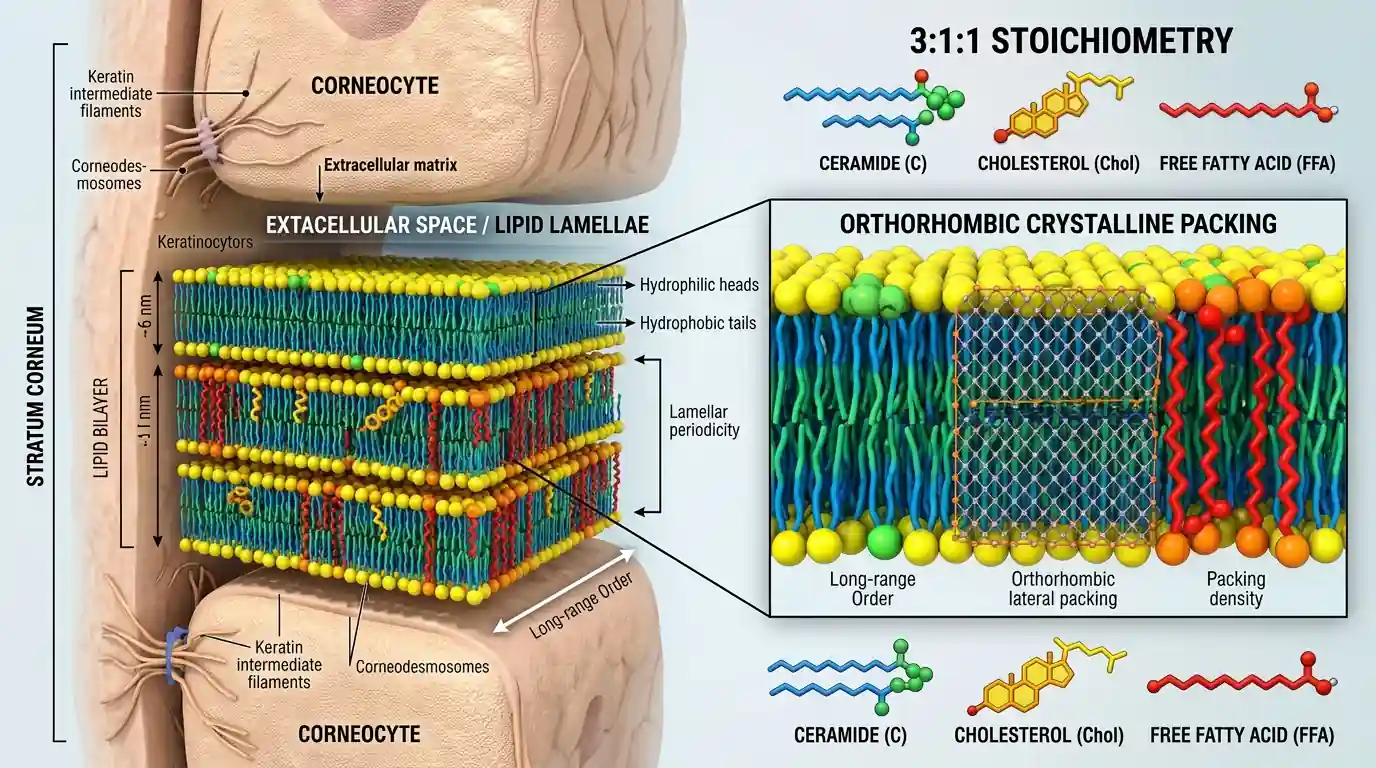
1. The Elias & Feingold Foundation: The Fallacy of Monotherapy Lipids
In classical dermatology, the stratum corneum is conceptualized through Dr. Peter M. Elias's famous "Brick and Mortar" model. The anucleated, protein-rich corneocytes constitute the bricks, while the continuous intercellular extracellular lipid matrix forms the mortar.
Unlike any other biological membrane in the human body, the stratum corneum lipid mortar contains virtually zero phospholipids. Instead, it is composed of three distinct equimolar lipid species:
Ceramides (Sphingolipids)
Comprising 12 distinct subclasses (including Ceramide NP, AP, EOP, EOS). Ceramides feature ultra-long saturated acyl chains that assemble the structural backbone of lipid bilayers.
Cholesterol (Sterols)
Acts as a bidirectional membrane fluidity buffer. Rigid steroid rings insert between ceramide tails to prevent phase separation and eliminate fragile crystalline voids.
Free Fatty Acids (FFAs)
Predominantly non-essential saturated fatty acids (palmitic and stearic acids). The ionizable carboxylic acid headgroups preserve the stratum corneum's antimicrobial acidic pH mantle (pH 4.8–5.5).
The Groundbreaking 1996 Discovery (PMID: 8618046)
In landmark research published in the Journal of Clinical Investigation by Man, Feingold, and Elias, scientists stripped the cutaneous barrier with acetone and evaluated lipid applications. Their findings revolutionized barrier science:
// 1. Monotherapy Failure:
Applying pure ceramides alone, pure cholesterol alone, or pure fatty acids alone impaired and significantly delayed barrier recovery compared to leaving the skin untreated.
// 2. Dual-Component Failure:
Applying two-component mixtures (e.g. Ceramide + Cholesterol without FFAs) failed to restore normal recovery curves.
// 3. Three-Component Triad Requirement:
ONLY complete mixtures containing all three physiologic lipid species allowed normal barrier restoration.
// 4. Optimized Ceramide-Dominant 3:1:1 Ratio:
When the molar fraction of ceramides was elevated to a 3:1:1 ratio (Ceramides : Cholesterol : FFAs), barrier recovery kinetics accelerated significantly beyond native healing speeds.
To integrate physiologic lipid ratios into a complete barrier rehab plan, review The Reactive Skin Barrier Rehabilitation Protocol.
2. Lamellar Biophysics: Orthorhombic Crystalline Packing & Acylceramides
Why does stoichiometry matter so profoundly? The physical impermeability of the stratum corneum depends on how lipid hydrocarbon tails organize in three-dimensional space. Through synchrotron small-angle (SAXD) and wide-angle X-ray diffraction (WAXD), biophysicists have identified the crystalline architecture that seals the barrier:
A. Orthorhombic Lateral Packing vs. Hexagonal Packing
In healthy skin, hydrocarbon chains pack into an extraordinarily dense, rectangular orthorhombic lattice (yielding signature X-ray reflections at 0.41 nm and 0.37 nm). Because the lipid tails are tightly compressed, there is negligible intermolecular free volume, creating an impermeable barrier against water vapor and irritants. When ceramides are deficient, the lattice relaxes into a looser hexagonal packing or fluid liquid-disordered state, dramatically increasing transepidermal water loss (TEWL).
B. Long-Periodicity Phase (LPP ~13 nm) & Ceramide EOS
Stratum corneum lipid lamellae alternate between two distinct repeating phases: the Short-Periodicity Phase (SPP ~6 nm) and the Long-Periodicity Phase (LPP ~13 nm). Formation of the water-impermeable LPP is strictly dependent on acylceramides, predominantly Ceramide EOS (Ceramide 1). Featuring an ultra-long ω-hydroxy C30–C32 fatty acid esterified to linoleic acid, Ceramide EOS spans across adjacent lamellar bilayers, acting as a molecular rivet that staples the lipid sheets to the cornified envelope.
If the barrier has entered a hyper-reactive cycle with perioral erythema from overuse of heavy occlusives, consult our elimination strategy in Perioral Dermatitis Zero-Therapy.
3. The Cellular Factory: Lamellar Bodies & Enzymatic Processing
In viable epidermal layers, lipid synthesis occurs in specialized secretory organelles within the stratum granulosum called Lamellar Bodies (Odland bodies).
Keratinocytes do not package free ceramides into lamellar bodies because unesterified ceramides induce apoptosis. Instead, they synthesize water-soluble polar precursors: glucosylceramides and sphingomyelin. Along with precursors, lamellar granules package essential processing hydrolytic enzymes:
- β-Glucocerebrosidase (β-GlcCer'ase): Operates at acidic pH 5.0 to cleave glucose from glucosylceramides, liberating mature Ceramides NP, AP, and EOS.
- Acid Sphingomyelinase (aSMase): Cleaves phosphocholine from sphingomyelin to generate Ceramides NS and AS. Genetic defects or surfactant inhibition of aSMase causes severe xerosis and barrier collapse.
- Secretory Phospholipase A2 (sPLA2): Hydrolyzes membrane phospholipids into free fatty acids (palmitic, stearic), which drive the acidification of the stratum corneum.
Upon reaching the boundary between the stratum granulosum and stratum corneum, lamellar bodies fuse with the apical keratinocyte membrane and exocytose their lipid discs into the extracellular space. Topical application of a 3:1:1 physiologic formulation mimics this natural exocytosis, directly replenishing the hydrolytic lipid pool and signaling the stratum granulosum to upregulate native lamellar body secretion.
For botanical active pairings that stimulate underlying collagen matrices alongside lipid repair, explore Centella Asiatica & Asiaticoside Barrier Speeds.
4. Prescription EpiCeram vs. Standard OTC Moisturizers: The Molecular Reality
Why do over-the-counter ceramide moisturizers often fail patients with severe eczema, reactive flushing, or steroid-induced skin thinning? The answer lies in formulation stoichiometry:
EpiCeram & Physiologic Devices
- Engineered with a validated 3:1:1 molar ratio (Ceramides : Cholesterol : Free Fatty Acids).
- High total physiologic lipid concentration (≥ 5% active lipids).
- Non-ionic lamellar liquid-crystal vehicle that self-assembles into 13 nm LPP bilayers.
- Clinically demonstrated to equal mid-potency topical corticosteroids (fluticasone) in SCORAD reduction without steroid atrophy (PMID: 18429949).
Standard OTC Formulations (e.g. CeraVe)
- Ceramides are included at trace levels (< 0.1%) primarily for marketing claims.
- No disclosed or maintained molar ratio; dominated by non-physiologic synthetic emollients, mineral oil, and petrolatum.
- Multi-vesicular emulsion (MVE) delivers simple surface humectancy (hyaluronic acid, glycerin) rather than lamellar structural remodeling.
- Provides pleasant temporary occlusion but fails to correct deep biochemical ceramide deficits in inflamed epidermis.
Clinical Benchmarks for Formulators
When auditing or compounding a true physiologic barrier rehabilitation product:
- Verify that Ceramides (NP, AP, EOP/EOS) represent at least 50% to 60% of the total lipid fraction.
- Ensure Cholesterol is present at approximately 20% to 25% molar concentration to prevent phase separation voids.
- Incorporate saturated Free Fatty Acids (Palmitic or Stearic Acid) at 15% to 20% to preserve the acid mantle.
- Maintain a total active lipid threshold of at least 3.0% to 5.0% in the finished emulsion.
Frequently Asked Questions: Ceramide Stoichiometry
Why is an isolated ceramide cream ineffective or detrimental without cholesterol and free fatty acids?
Landmark research by Dr. Peter Elias and Dr. Kenneth Feingold demonstrated that the stratum corneum lipid matrix requires an exact equimolar stoichiometry of three key physiologic lipids: ceramides, cholesterol, and free fatty acids. Applying one or two lipids in isolation (such as a 100% ceramide serum) disrupts native lipid organization, creates defect phase boundaries, and delays normal barrier recovery curves compared to untreated controls.
What is the difference between equimolar 1:1:1 and ceramide-dominant 3:1:1 ratios?
The equimolar 1:1:1 molar ratio represents the baseline structural equilibrium of healthy, intact human stratum corneum. However, in acutely compromised, inflamed, or atopic skin, native ceramide synthesis by lamellar bodies is severely depleted. Formulating with an optimized 3:1:1 ceramide-dominant ratio (3 parts ceramides to 1 part cholesterol and 1 part free fatty acids) overcompensates for this biochemical deficit, driving rapid lamellar body exocytosis and accelerating transepidermal water loss (TEWL) recovery.
What is orthorhombic crystalline packing, and why does it matter for water loss?
Intercellular stratum corneum lipids pack into distinct lateral geometries: orthorhombic, hexagonal, and liquid-disordered. Orthorhombic packing is the most dense, tightly packed crystalline lattice, characterized by X-ray diffraction reflections at 0.41 nm and 0.37 nm. This tight, ordered hydrocarbon alignment minimizes intermolecular free volume, making the lipid lamellae virtually impermeable to water vapor and airborne irritants.
How does prescription EpiCeram differ from over-the-counter ceramide moisturizers?
Prescription barrier devices such as EpiCeram are formulated with a strict, patented 3:1:1 ceramide-dominant physiologic molar ratio utilizing >=5% total barrier lipids designed to mimic the natural lamellar architecture of the skin. In contrast, mass-market OTC moisturizers typically contain trace ceramide concentrations (<0.05% to 0.1%) dispersed in standard petrochemically occlusive vehicles (petrolatum, dimethicone) that do not self-assemble into native orthorhombic lipid lamellae.