Demodex Blepharitis: Eyelid Scrubs, Terpinen-4-ol & FDA Lotilaner Therapeutics
Patients suffering from ocular burning, chronic eyelid redness, morning crusting, and foreign-body sensation are frequently misdiagnosed with generic dry eye syndrome or seasonal allergies. In reality, over 58% of chronic blepharitis cases stem from an unmanaged parasitic infestation of Demodex mites. Eradicating these microscopic ectoparasites requires understanding the delicate biochemistry between toxic crude tea tree oil, isolated terpinen-4-ol, and revolutionary FDA-approved lotilaner eye drops.
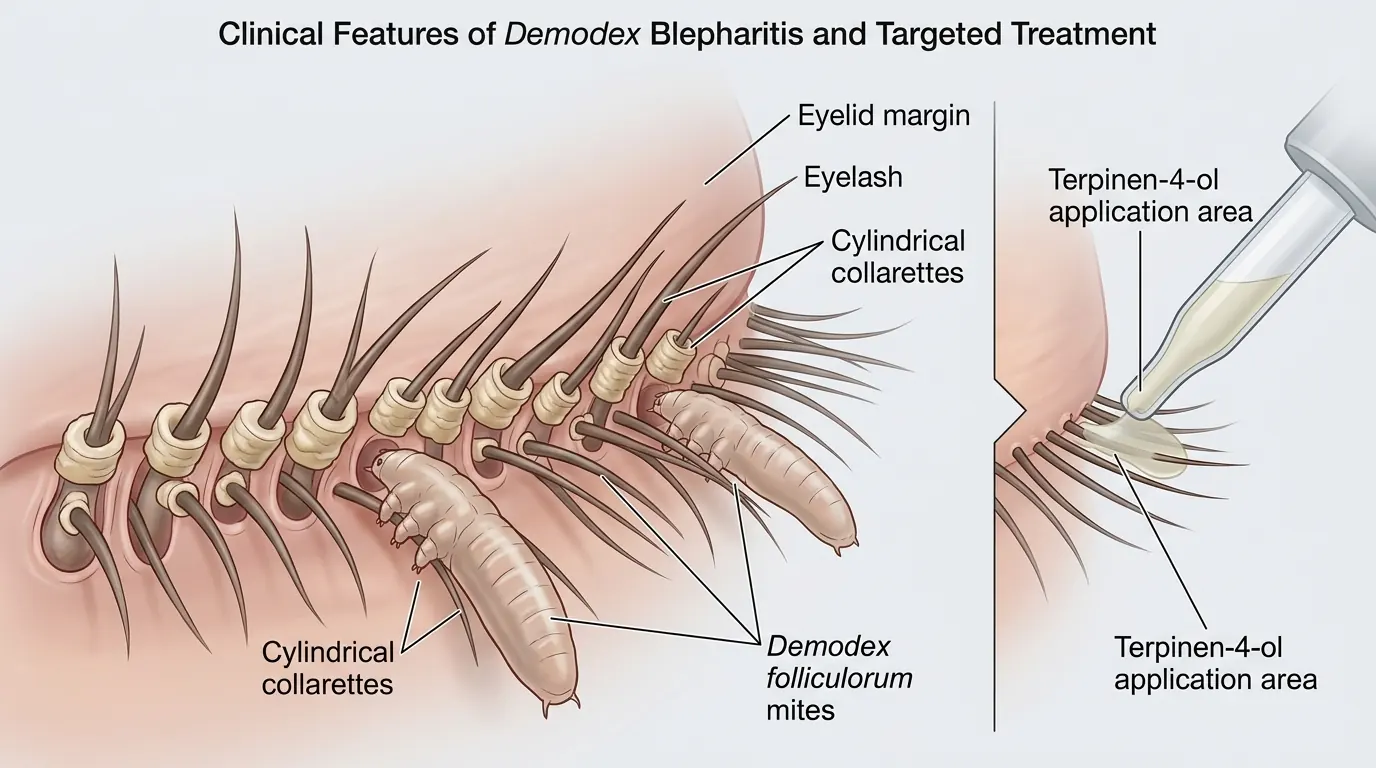
1. Parasitic Micro-Ecology: Demodex Folliculorum vs. Demodex Brevis
Humans host two distinct species of Demodex mites on facial anatomy. While microscopic and considered commensal at low population densities, their uncontrolled proliferation along the eyelid margin triggers devastating inflammation:
Demodex folliculorum (0.3 – 0.4 mm)
Clusters within the lash infundibulum and follicular hair follicles. The mites consume follicular epithelial cells, causing follicular distention, misdirected lashes (trichiasis), premature lash loss (madarosis), and pathognomonic cylindrical dandruff collarettes.
Primary Clinical Manifestation: Anterior BlepharitisDemodex brevis (0.15 – 0.2 mm)
Burrows deeply into the meibomian and Zeis sebaceous glands. Its presence physically occludes the gland ducts. Dead chitinous exoskeletons trigger granulomatous foreign-body reactions, culminating in recurrent chalazia, meibomian gland atrophy, and severe Meibomian Gland Dysfunction (MGD).
Primary Clinical Manifestation: Posterior Blepharitis & MGDCrucially, Demodex overgrowth does not occur in isolation. Over 80% of patients diagnosed with papulopustular or erythematotelangiectatic rosacea exhibit significant ocular Demodex density. Explore the cutaneous link in our comprehensive analysis: Rosacea Subtypes & Azelaic Acid Protocols.
2. The Pathognomonic Hallmark: Cylindrical Dandruff & Bacillus Oleronius
During slit-lamp biomicroscopy, ophthalmologists look for one definitive hallmark: cylindrical dandruff (CD), also termed collarettes. Collarettes are translucent, gelatinous or waxy cylindrical sleeves that wrap circumferentially around the base of the eyelash shaft as it emerges from the lid margin.
Why do collarettes form? Demodex mites are unique among arthropods in that they lack an excretory anus. As they ingest epithelial cells and sebum, they accumulate metabolic waste internally. At the conclusion of their 14-to-18-day lifecycle, or during periodic regurgitation, the mites expel undigested keratin debris, chitin fragments, ovum cases, and potent digestive enzymes directly into the follicular opening.
- Lipase Secretion: Demodex and their symbiotic bacteria secrete active lipases that hydrolyze polar meibomian lipids into irritating free fatty acids. This destabilizes the tear film lipid layer, drastically shortening Tear Break-Up Time (TBUT < 5 seconds) and accelerating evaporative dry eye.
- Protease Cleavage: Proteolytic enzymes digest the extracellular matrix of the lid margin, leading to chronic telangiectatic neovascularization and madarosis.
- Bacillus oleronius Antigens: Demodex mites carry endosymbiotic bacteria, primarily Bacillus oleronius. When mites die inside follicles, these bacterial proteins (62 kDa and 83 kDa antigens) trigger Toll-like Receptor 2 (TLR2) activation, flooding the ocular surface with Interleukin-1β, Interleukin-8, and TNF-α.
For patients with co-occurring fungal folliculitis or sebaceous dysbiosis, cross-reference our lipid tolerance guidelines in the Malassezia Comedogenicity Compendium.
3. Terpinen-4-ol Pharmacodynamics vs. Crude Tea Tree Oil Toxicity
For decades, tea tree oil (Melaleuca alternifolia / TTO) served as the primary clinical remedy for Demodex. However, crude tea tree oil is a complex botanical blend of over 100 terpene hydrocarbons. Many of these components—most notably 1,8-cineole (eucalyptol) and alpha-terpinene—are intensely toxic to ocular tissues, causing immediate chemical blepharoconjunctivitis, severe ocular surface burning, and corneal epithelial sloughing.
Groundbreaking research by Dr. Scheffer Tseng and colleagues isolated the single active demodicidal constituent: Terpinen-4-ol (T4O).
1. Highly lipophilic monoterpene alcohol that penetrates mite exoskeletons.
2. Potent competitive inhibitor of Acetylcholinesterase (AChE) in arthropods.
3. Synaptic acetylcholine accumulation → uncontrolled depolarization → rigid paralysis & death.
4. In vitro kill curve: 4% isolated T4O achieves 100% Demodex mortality in < 40 minutes.
5. Causes mites to vacate deep follicular burrows, migrating onto the lid surface where they are scrubbed away.
If eyelid scrubbing has left your peri-orbital skin raw and stripped, review gentle barrier rebuilding in The Reactive Skin Barrier Rehabilitation Protocol.
4. The Paradigm Shift: FDA-Approved Lotilaner (Xdemvy) & Clinical Protocols
In July 2023, the U.S. Food and Drug Administration fundamentally transformed blepharitis treatment by approving Xdemvy (lotilaner ophthalmic solution 0.25%)—the first and only direct, pharmacologic antiparasitic approved for Demodex blepharitis.
Isoxazoline Mechanism of Action
Lotilaner is an isoxazoline compound that non-competitively antagonizes GABA-gated chloride channels and L-glutamate-gated chloride channels in Demodex mites. By blocking chloride influx into arthropod nerve synapses, it induces rapid paralysis and death. Because mammalian GABA receptors have a structurally divergent subunit architecture, lotilaner exerts extraordinary selectivity for parasites without human ocular neural toxicity.
Pivotal Phase 3 Clinical Trial Data (SATURN-1 & SATURN-2)
Across two randomized, double-masked, vehicle-controlled trials enrolling 833 patients receiving one drop twice daily for 6 weeks:
- Complete Mite Eradication (0 mites/lash): Achieved in 67% (SATURN-1) and 49% (SATURN-2) of lotilaner patients vs. 14–17% for vehicle.
- Collarette Cure (≤ 2 collarettes/lid): Achieved in 56% of patients by Day 43, with significant reduction visible as early as Day 15.
- Safety Profile: Over 90% of patients rated drops as comfortable, with zero corneal endothelial damage or IOP spikes.
Comprehensive At-Home & In-Office Treatment Protocol
Modern clinical management combines mechanical biofilm removal with targeted medical therapy:
Step 1: In-Office Microblepharoexfoliation (BlephEx): A motorized medical micro-sponge cleanses the lid margin, physically debriding tough chitinous collarettes, biofilm, and crusting to unroof clogged meibomian orifices.
Step 2: Targeted Pharmacotherapy: Prescribe Xdemvy (lotilaner 0.25%) BID for 42 days (covering two complete Demodex egg-to-adult reproduction cycles).
Step 3: Terpinen-4-ol Maintenance Scrubs: For long-term hygiene post-treatment, use pre-moistened wipes standardized to ≤ 2–4% Terpinen-4-ol twice weekly to prevent mite recolonization from eyebrows and facial skin.
Frequently Asked Questions: Demodex Blepharitis
What is the clinical difference between Demodex folliculorum and Demodex brevis in eyelid disease?
Demodex folliculorum is longer (0.3–0.4 mm) and colonizes eyelash follicles and the lash infundibulum, primarily driving anterior blepharitis, lash trichiasis, and pathognomonic cylindrical dandruff collarettes. In contrast, Demodex brevis is shorter (0.15–0.2 mm) and burrows deeply into the meibomian and Zeis sebaceous glands, causing posterior blepharitis, Meibomian Gland Dysfunction (MGD), recurrent chalazia, and evaporative dry eye syndrome.
Why are cylindrical dandruff collarettes considered pathognomonic for Demodex infestation?
Cylindrical collarettes are clear to waxy cuff-like sleeves encircling the base of the lash shaft. Because Demodex mites lack an excretory anus, they digest epithelial cells and sebum and periodically regurgitate undigested matter, keratin, chitinous waste, and microbial enzymes (lipases and proteases) at the follicular opening. Clinical slit-lamp identification of collarettes has a near 100% correlation with active Demodex proliferation.
Why is isolated Terpinen-4-ol safer than raw crude Tea Tree Oil for eyelid margins?
Crude tea tree oil (Melaleuca alternifolia) contains over 100 chemical constituents, including volatile 1,8-cineole and alpha-terpinene, which cause severe stinging, allergic contact dermatitis, and direct corneal chemical burns. Terpinen-4-ol (T4O) is the isolated, active monoterpene that paralyzes Demodex mites via acetylcholinesterase inhibition. While purified T4O avoids cineole toxicity, it must still be formulated at precise concentrations (e.g., 1% to 4%) because high concentrations remain toxic to Human Meibomian Gland Epithelial Cells (HMGECs) upon prolonged contact.
How does Xdemvy (lotilaner ophthalmic solution 0.25%) eradicate Demodex mites?
Approved by the FDA in July 2023, Xdemvy (lotilaner 0.25%) is an isoxazoline antiparasitic drug administered as one eye drop twice daily for 6 weeks. Lotilaner selectively antagonizes GABA-gated chloride channels in Demodex mites, inducing flaccid paralysis and death. Pivotal Phase 3 trials (SATURN-1 and SATURN-2) demonstrated complete mite eradication in up to 67% of patients and complete collarette cure without corneal epithelial toxicity.